Behavioral interview questions: how to ask them and read the answers
The best predictor of how someone will behave at work is how they've behaved before. That's the whole idea behind behavioral interview questions: instead of asking what someone would do, you ask what they did. Past behavior beats good intentions, and a candidate can't rehearse their way around a real story as easily as they can a hypothetical.
Here's how to ask behavioral questions well, what a strong answer sounds like, and the red flags to catch.
Why "what would you do" falls short
Ask "how would you handle a difficult customer?" and you'll get a polished, theoretical answer that anyone can give. Ask "tell me about a difficult customer you handled" and you get a real situation with real choices and a real outcome. The second question is far harder to fake and far more revealing, because it shows you what the person genuinely does under pressure, not what they know they should say.
How to phrase them
Behavioral questions almost always start the same way: "Tell me about a time..." or "Describe a situation where..." Aim at the traits the role truly needs. A few examples:
- Tell me about a time you missed a deadline. What happened, and what did you do?
- Describe a time you disagreed with a colleague. How did you handle it?
- Tell me about a goal you set and how you reached it.
- Describe a time you had to learn something quickly to get a job done.
- Tell me about a decision you made that turned out to be wrong.
- Describe a time you handled several priorities at once.
Pick four or five that match what matters most in the role, and ask the same ones of every candidate.
What a strong answer sounds like
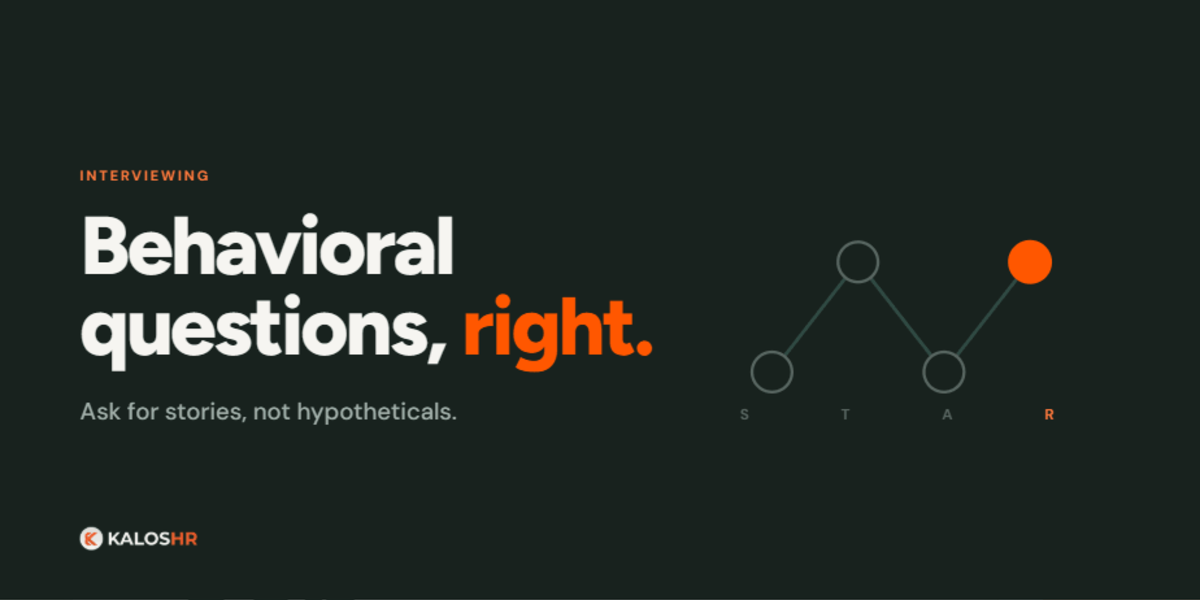
Good answers have a shape, often called STAR: the situation, the task they faced, the action they personally took, and the result. You don't need to grade it like an exam, but listen for those pieces. A strong answer is specific, owns the person's own role ("I decided," not "we sort of"), includes what they'd do differently, and ends with a real outcome. The candidate isn't the hero of every story; they're honest about what worked and what didn't.
The red flags to catch
Behavioral questions are useful partly because of what weak answers reveal:
No real example. If "tell me about a time" gets a hypothetical ("well, I'd usually..."), they may not have done it. Press gently for a specific instance.
All "we," no "I." Someone who never says what they personally did may be borrowing credit. Ask, "what was your part in that?"
No reflection. A candidate who has never gotten anything wrong, or learned nothing from it, lacks self-awareness. The best people own their mistakes.
A story with no end. If they can't tell you how it turned out, they may not have owned the outcome.
Probe, don't accept the first answer
The real signal often comes after the first answer. When a story stays vague, ask "what happened next?", "what was your specific role?", or "what would you do differently now?" Those follow-ups separate people who lived the story from people who are constructing it on the spot.
Keep the evidence
Behavioral interviews only work if you remember what was said, and after four candidates the stories blur. Capture your notes right after each conversation, against the candidate, while it's fresh. In KalosHR you can save interview notes on each candidate's profile and review every answer side by side when it's time to decide, so you're comparing real evidence rather than a hazy memory of who you liked.
Behavioral questions take a little more skill to run than "what's your weakness," and they're worth it. Ask about the past, listen for the specifics, and you'll predict performance far better than any hypothetical can.